
The campaign ends.
The learning shouldn’t.
Every campaign creates knowledge that can make the next one better. Too often, that knowledge disappears when staff leave, systems close, and attention moves immediately to what’s next.
The Viovera Post-Campaign Analysis preserves the record, reconstructs the campaign, examines the decisions and outcomes that mattered, and turns campaign experience into intelligence for what comes next.
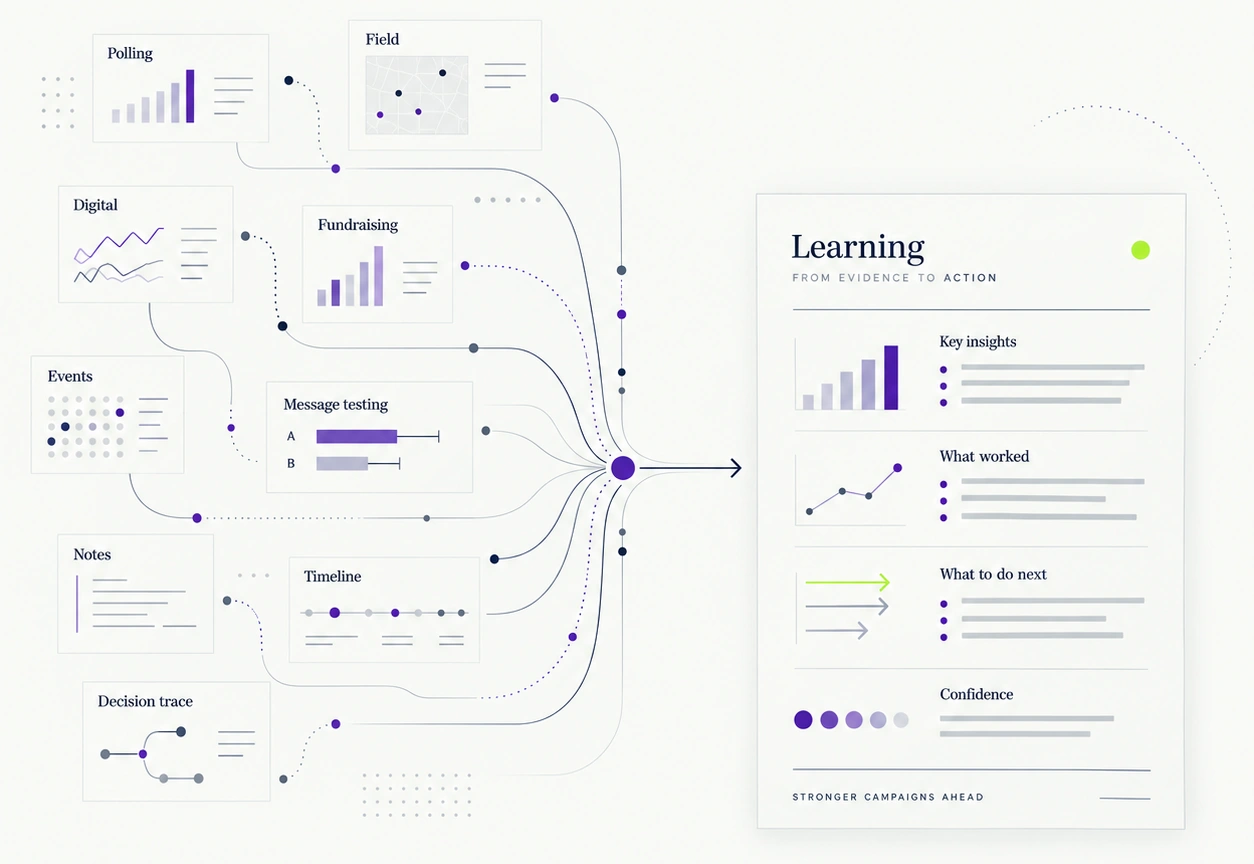
Campaigns move fast.
Institutional memory disappears faster.
Campaigns are temporary organizations making consequential decisions under constant pressure. By the time the campaign ends:
- Staff are already moving on
- Systems and accounts begin shutting down
- Important decisions have lost their context
- Lessons live in individual memories
- Data remains fragmented across teams and vendors
- Hindsight begins rewriting what people believed at the time
A campaign wrap-up can capture what happened.
A Viovera Post-Campaign Analysis is designed to help explain what mattered, how decisions were made, and what should shape what happens next.

From campaign history to campaign intelligence.
The Post-Campaign Analysis follows a five-stage process designed to preserve what happened, understand why it mattered, and make what was learned usable.
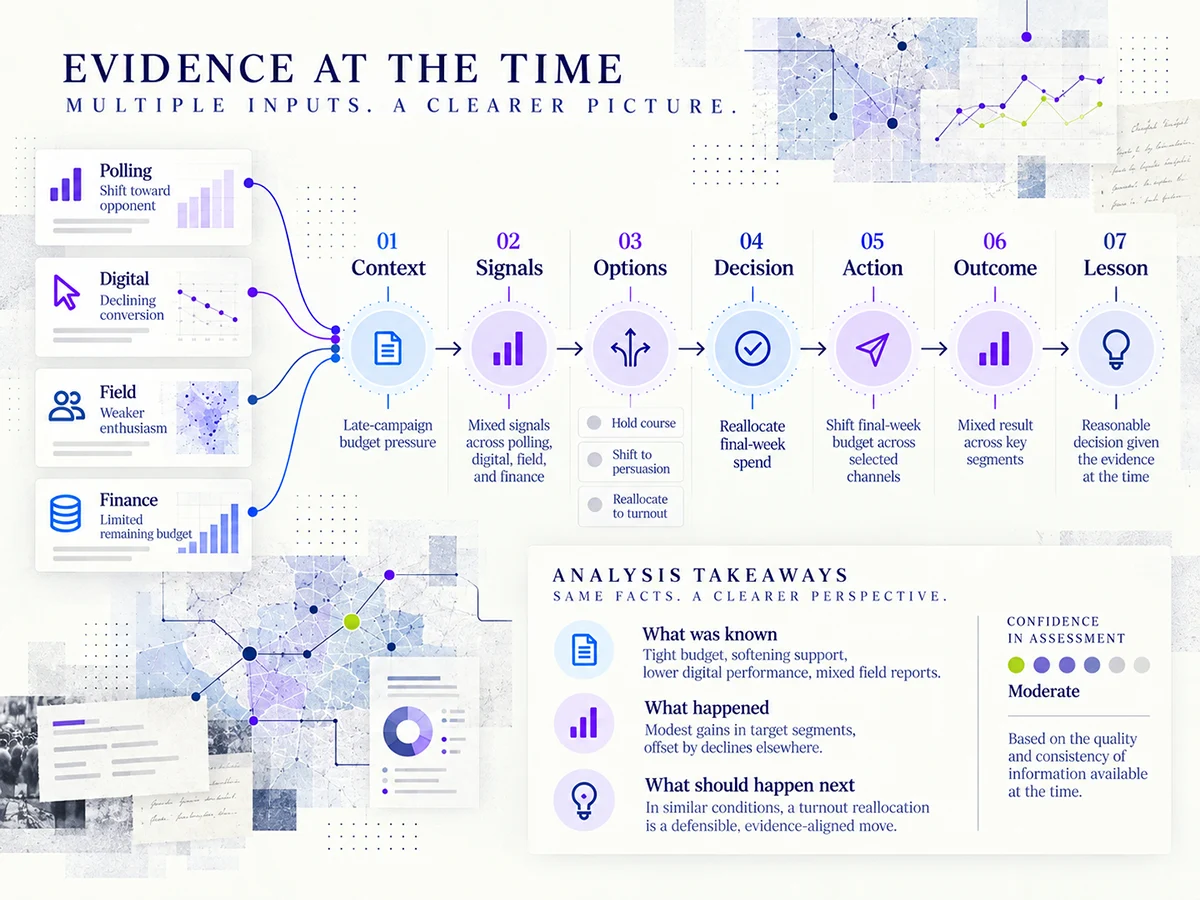
Important decisions deserve more than hindsight.
Campaign decisions are often judged using information that was unavailable when the decision was actually made. We reconstruct important decisions using the information, constraints, and conditions that existed at the time.
The goal is not simply to ask whether every decision ultimately produced the desired outcome. The goal is to understand how the decision was made, whether it was reasonable given the information, capabilities, constraints, and alternatives available at the time, and what future leaders should learn from it.
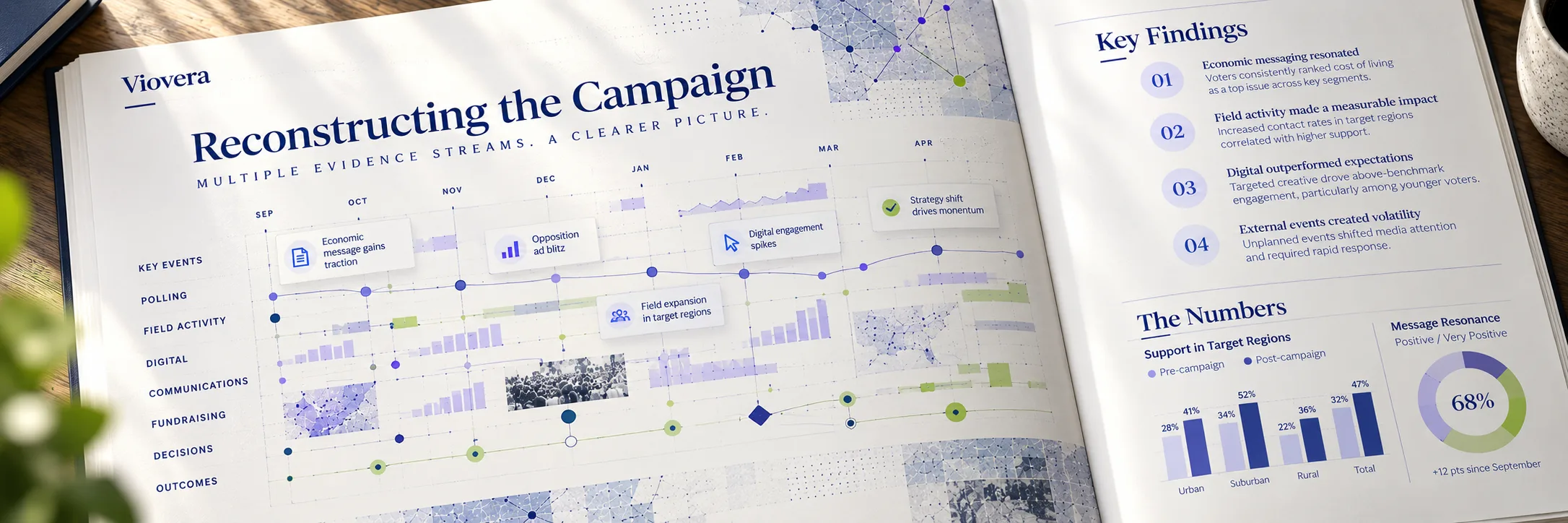
See the campaign as a system—not a series of isolated moments.
Campaigns unfold across teams, channels, decisions, external events, and new information.
A campaign reconstruction brings relevant evidence onto a shared chronology so leaders can see what was known, what changed, which decisions followed, and what happened next. Depending on the engagement, that may include signals from polling, fundraising, field, communications, digital performance, campaign finances, major events, and other relevant sources.
Have a campaign worth learning from?
We can talk through what evidence exists, what questions matter, and whether a Post-Campaign Analysis would be useful.
We won’t pretend to know what the evidence can’t tell us.
Post-campaign narratives can become too certain, too quickly. Viovera distinguishes among:
Evidence-supported findings
The available evidence strongly supports the conclusion.
Reasonable inference
Evidence points toward an explanation, while alternatives remain plausible.
Hypotheses
Potential explanations that deserve consideration or further testing.
Unknowns
Important questions the available evidence cannot responsibly answer.
Good intelligence is not the absence of uncertainty. It is clarity about where uncertainty exists.
What a Post-Campaign Analysis can produce.
Depending on engagement scope, a Post-Campaign Analysis may include:
Campaign Evidence Inventory
A structured record of the information reviewed, evidence available, and important gaps.
Campaign Reconstruction
A visual chronology connecting important campaign events, signals, decisions, and performance.
Analysis & Findings Report
The evidence, analysis, findings, decision reviews, lessons, and recommendations.
Leadership Debrief
A facilitated working session designed to challenge conclusions and turn analysis into shared learning.
Action Brief
A concise guide to what should be preserved, changed, built, tested, and watched before the next campaign.
Built for people and organizations who intend to keep doing the work.
Viovera works with progressive, mission-aligned leaders and organizations:
- Candidates and campaign leadership
- Unions
- PACs and political organizations
- Mission-aligned nonprofits
- Parties and committees
- Political consulting firms
- Advocacy organizations
- Organizations managing multiple campaigns
One campaign may end. The organization’s ability to learn from it shouldn’t.

Post-Campaign Analysis FAQ
Ideally, before the campaign ends. Once a campaign is operating at a level where its decisions, data, and institutional knowledge will matter later, preservation can begin. Important decisions, evidence, and context can be documented as the campaign unfolds, while the full analysis and debrief take place after the campaign concludes.
No. Winning campaigns can be particularly valuable to study because success can conceal mistakes just as easily as defeat can conceal things that worked.
No. The purpose is organizational learning and future decision-making rather than regulatory, financial, or individual-performance auditing.
We examine the factors that the available evidence indicates were important. Campaign outcomes are complex, and we will not manufacture causal certainty where the evidence does not support it.
Viovera follows a minimum-necessary approach and avoids collecting sensitive information that is not required for the engagement.
Interview expectations, attribution rules, and confidentiality terms are established at the beginning of the engagement so participants understand how their input will be used.
Yes. Relevant external partners may provide important evidence and perspectives when appropriate to the engagement.
Data access, retention, return, and deletion expectations are established as part of the engagement.
Every campaign is different. Scope depends on the size and complexity of the campaign, the questions being examined, available evidence, and the number of stakeholders involved. Contact Viovera to discuss the appropriate scope.
Don’t let the campaign disappear.
The best time to preserve the campaign’s knowledge is while the people, systems, decisions, and evidence are still accessible.
Let’s talk about what your campaign can teach you and what it could mean for the work ahead.